The Scandalous Swimwear of Harbour Grace

Most of the stories I share here begin as something else entirely. I'll set out researching one corner of Newfoundland history and end up discovering a story I wasn't looking for. That's exactly what happened when I came across the following letter in the August 4, 1877 edition of the Harbour Grace Standard.
The writer's complaint? Young men weren't wearing enough while swimming. Their proposed solution was every bit as interesting as the problem.
Here’s the letter:
Dear Sir,
For some time past, numbers of boys, and even young men, have been almost daily in the habit of disporting themselves in a state of partial nudité in and about our public coves and wharves, much to the disapproval and disgust of the inhabitants.
Now, we think these places referred to should on no account be made the resort of bathers, when a more retired and convenient place can be availed of near at hand. Public decency demands its discontinuance; and if young persons persist in openly violating the claims of common decency, and are themselves entirely lost to all sense of shame, they should not be allowed to carry on such practices - which are so revolting to the feelings of others. We wonder why the Police Force whose duty it certainly is —allows this conduct to pass unchallenged. Why does not High Constable Fallon — who is ever on the qui vive to discover offenders against the law — place his men under orders to take cognizance of the perpetrators, and introduce measures to prevent the recurrence of this obnoxious practice - this outrage on the public decency? Horse-whipping, in our opinion, would be the most effectual method of dealing with the delinquents. One or two dozen feelingly applied, would no doubt go far towards removing the nuisance. Should this course prove unsuccessful, we shall be prepared to recommend another modas operandi.
Yours, &c.,
NYMPH
In short, the writer took a very dim view of the swimming habits of Harbour Grace's young men and boys, who apparently weren't wearing nearly enough while splashing around the town's wharves and coves. Their suggested fix was decidedly Victorian: have the police catch the culprits and give them a whipping. If that didn’t work, well, the writer was willing to entertain other consequences.

Water Nymph, John Reinhard Weguelin (1900), Public domain, Wikimedia Commons
Whether the writer was in a genuine moral panic or just entertaining themselves with a jab toward those who were clutching their pearls is difficult to say with absolute certainty but the signature line strongly hints at the latter. It's signed "NYMPH." Water nymphs from Greek mythology weren't exactly known for prudishness, and a water spirit writing to complain about scantily-clad swimmers. Well, that's a rather good joke… and not one likely to be perpetrated by someone who had a genuine concern.
And then, there is the proposed remedy. It comes across less like law-and-order and more like the premise of a Victorian fetish magazine, at least to the modern reader.
It probably read that way at the time, too.
All-Wool, DoublE-Yoke
All that said, the late 1800s was a time of diverse and changing values when it came to acceptable dress for swimming.
In the 1860s laws were passed in England to halt men from swimming nude. Prior to that, it wasn’t an uncommon practice. Some 20 years later, the following illustration appeared in the Strawbridge & Clothier's catalogue from the United States:
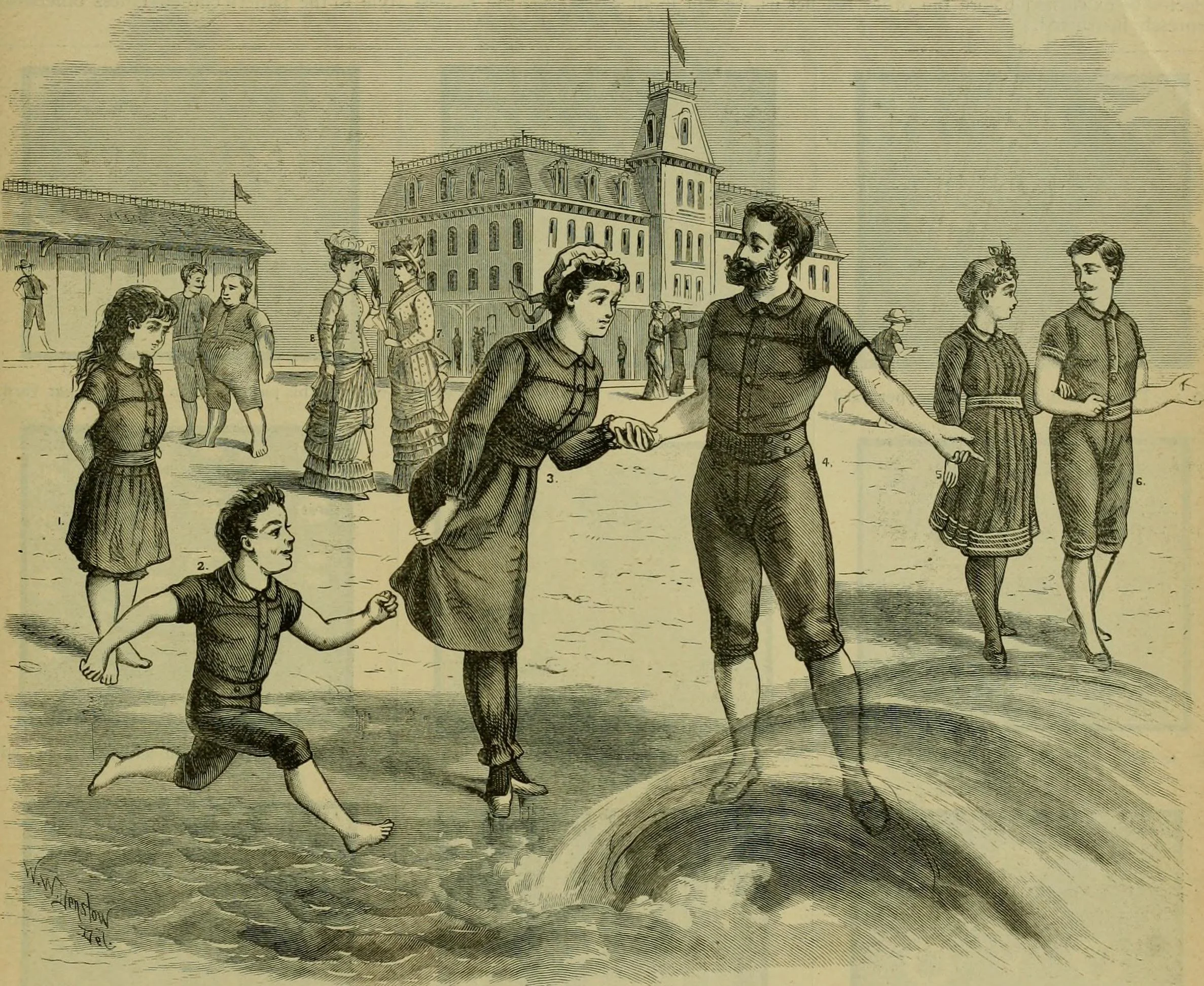
Bathing Suits, Strawbridge & Clothier's Quarterly, Internet Archive Book Images, No restrictions, via Wikimedia Commons
It was advertising a one-piece, all-wool men’s bathing suit with a double yoke and wide belt. It was described as close-fitting and adapted for swimming. There was certainly nothing scanty about it, I’ll give them that.
The Newfoundland Attitude
I don't know what the prevailing attitudes toward swimwear were in Newfoundland at the time. But considering how divided opinion was in England and the United States, it's reasonable to assume Newfoundlanders weren't all of one mind either.
Perhaps this letter reflects that debate… or maybe pokes fun at it.
-
Correspondence, Harbor Grace Standard, Aug, 4, 1877
Promiscuous Throng, Jane Darcy, Times Literary Supplement
History of Swimwear, Wikipedia.org
Strawbridge and Clothier's Quarterly (1883), Wikimedia Commons


_(14596035080).jpg)