Margaret Campbell Macpherson: St. John’s to Paris
Picture it: Paris, 1894.
The newly constructed Eiffel Tower dominates the skyline, the streets are bustling with people, and the galleries are crowded with paintings by artists from across Europe and beyond. Among the works on show is one by a woman born more than 4,000 kilometres away, across the ocean in St. John’s, Newfoundland.
Her name is Margaret Campbell MacPherson.
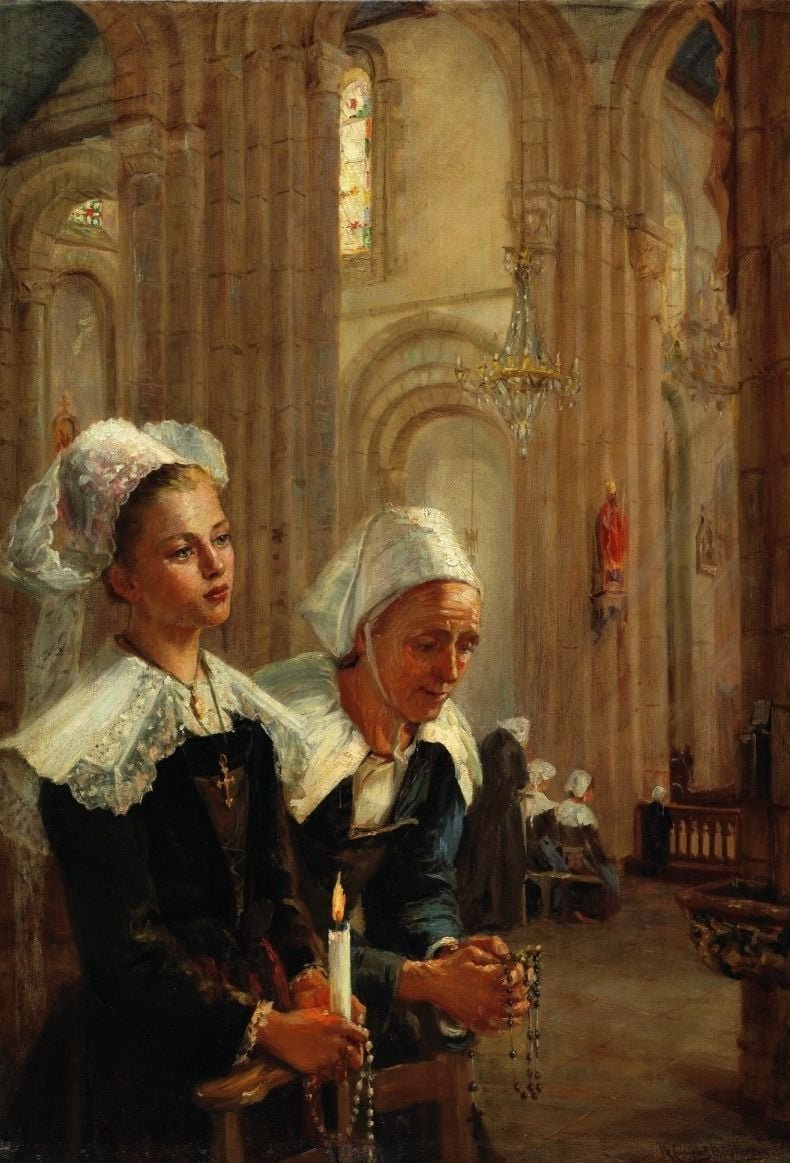
'Church interior in Brittany' (ca. 1897), Margaret Campbell MacPherson, Public domain, via Wikimedia Commons
Margaret Campbell MacPherson
In 1894, Macpherson’s work was being exhibited at the Paris Salon. It was a significant accomplishment. At this point, she was in her thirties, and had already spent much of her life pursuing art far from her home in Newfoundland. After completing her early education in St. John’s, she moved to Edinburgh, studied painting in Switzerland, and, in 1889, went to Paris, where she enrolled at the Académie Colarossi.
Macpherson’s showing at the Salon was really just the beginning. She would return to the Paris Salon again and again in the following years, and earn accolades on both sides of the Atlantic.
Signing her work simply “M. Campbell MacPherson,” she was a successful, professional artist with an international career — a remarkable achievement by any measure, and particularly so at a time when the art world did not always recognize the accomplishments of women.
“[W]e do have an interesting example of a woman from the 19th century, Margaret Campbell MacPherson, who left Newfoundland and, amazingly, made a full [art] career living mainly in France. She is probably the most exhibited woman of her particular era.”
MacPherson painted a range of subjects but she found particular inspiration in Brittany, where she depicted the people and landscapes around the artists' colony at Concarneau. It was her paintings of the people of Brittany, often shown in traditional dress, that would become among the most celebrated works of her career.
Through much of her career, she was accompanied by fellow artist Josephine Hoxie Bartlett, who had become an important part of both her professional and personal life. The artists shared a studio in Edinburgh, exhibited together, and eventually made their home in France.
But she didn’t leave Newfoundland behind. MacPherson returned to the island, painted landscapes and, in 1899 was the subject of a large exhibition at the Colonial Building in St. John’s.
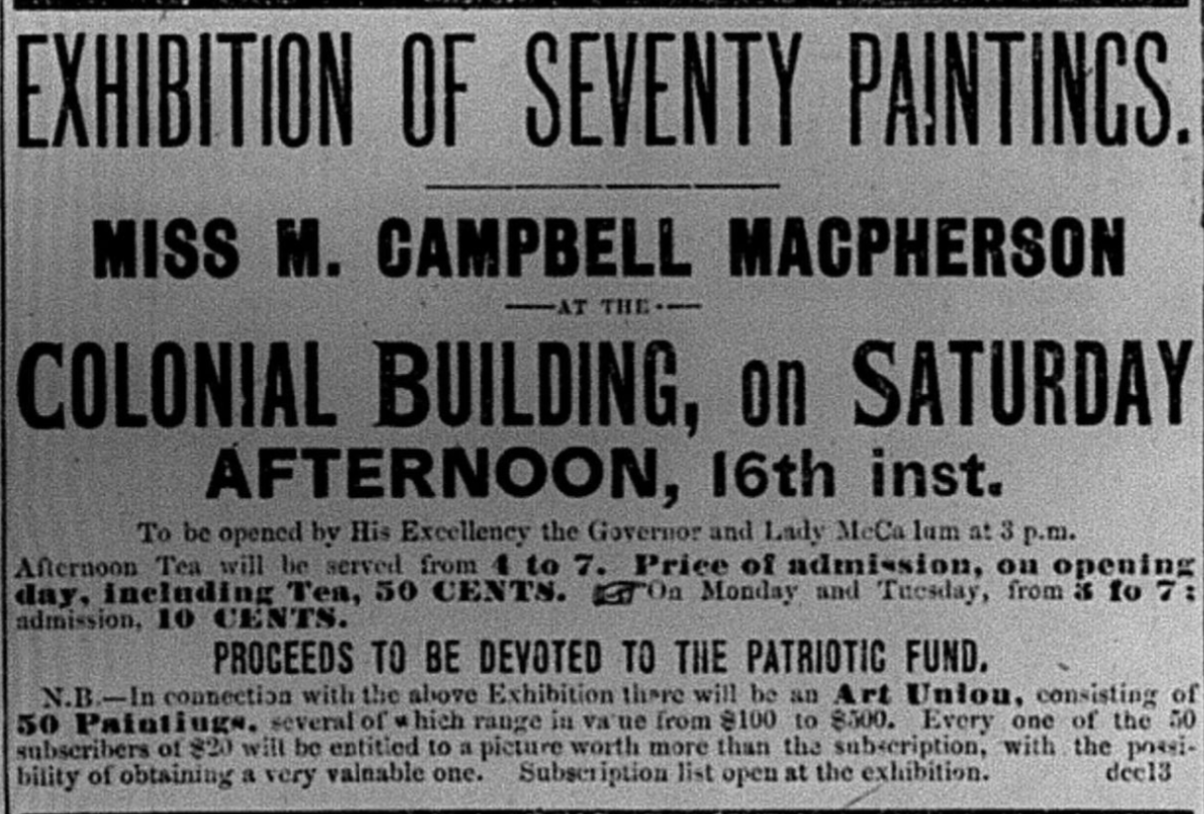
The choice of venue — the legislature — gives us some idea of how highly she was regarded at the turn of the 20th century. She was clearly respected, and recognized for the formidable artistic talent that she was.
MacPherson returned to France. Her work was shown at major exhibitions in Europe and North America, and in 1900 she won a bronze medal at the Exposition Universelle (World’s Fair) in Paris. Gold medals followed at other French exhibitions.
She continued painting and exhibiting for decades, maintaining a life in France while still identifying herself as a Newfoundlander. In her 1919 will, written in Paris, she described herself as “of St. John's, Newfoundland but temporarily residing in France.”
She died in Versailles in 1931.
And then she seems to have slipped from local memory.
Remembering M. Campbell MacPherson
Her paintings remained in private collections, and one was included in a Newfoundland Historic Trust exhibition in 1972. But for much of the twentieth century, Margaret Campbell MacPherson seems conspicuously absent from the story of Newfoundland art.
Then, more than 70 years after her death, she began to reappear.
In 2006, the Art Gallery of Nova Scotia organized Two Artists Time Forgot, an exhibition devoted to her work. When the show came to The Rooms in St. John’s in 2007, Macpherson’s paintings were once again on display in the city where her story began, which seems fitting.
Newfoundland never lost its place in MacPherson’s story; we should make sure she never loses her place in ours. Perhaps the best way to do that is simply to keep looking at her work. The Rooms’ online database lists eight works by Macpherson in its collections, that gives us a pretty good place to start.
-
Curator Conversations: Ladylikenes, Glenbow
A Pastel and a Photograph Propped up on a Windowsill, caralockhartsmith
Exhibition of Seventy Paintings, Evening Herald, Dec 14, 1899
Margaret Campbell MacPherson, ArtUK
Gathering Apples in an Orchard – Brittany, Leighton Fine Art
Two Artists Time Forgot, Internet Archive
M. Campbell Macpherson Will, Newfoundland Grand Banks
Artist Margaret Campbell MacPherson, Genealogy.com