What the Heck is Newfoundland Nectar?
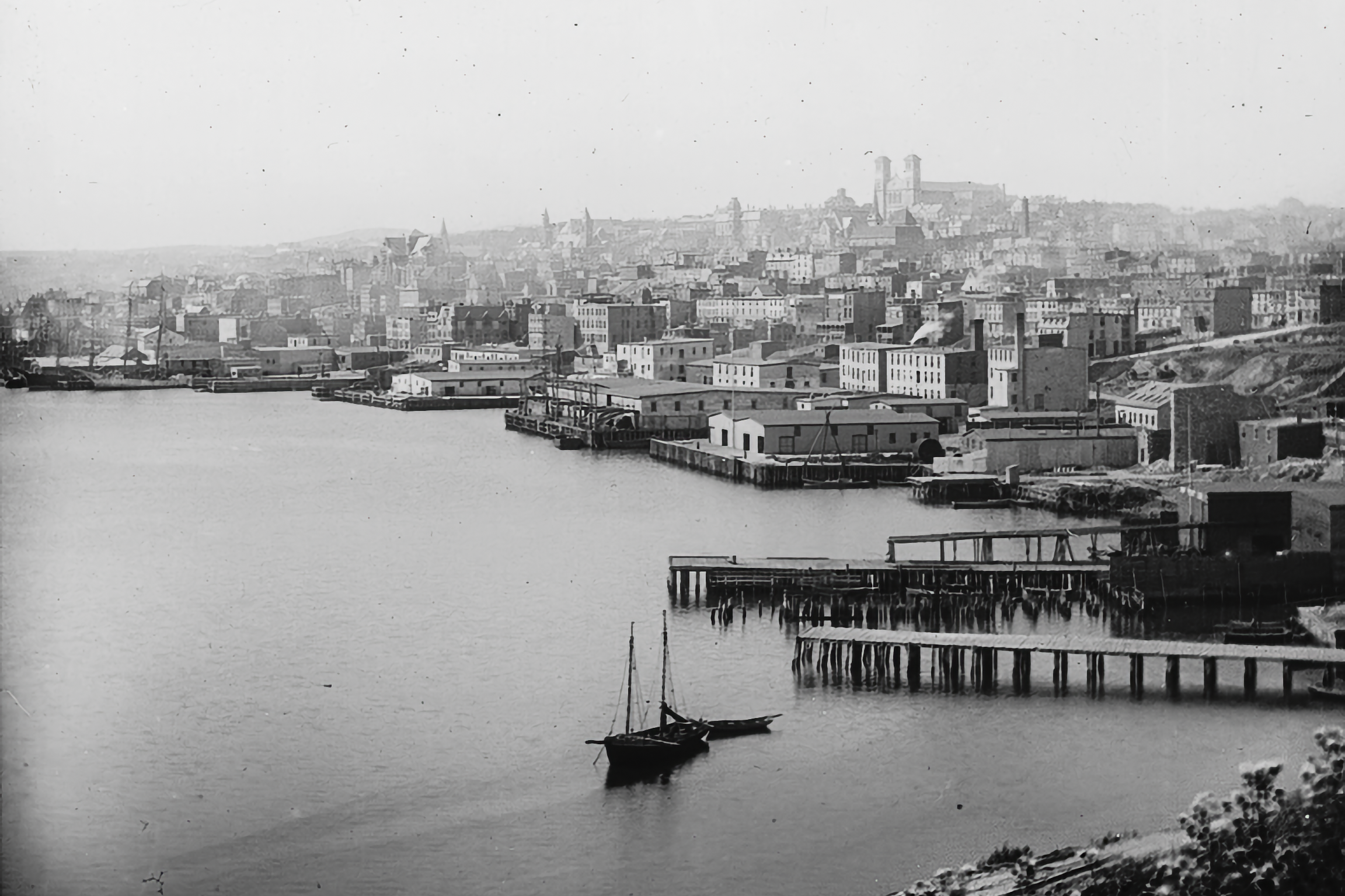
St. John’s (1892), Public domain, via Wikimedia Commons
Writing for Product of Newfoundland, I get sidetracked. A lot.
I’ll be reading everything I can find about some murder, old superstition or heroic deed when — out of the blue — something completely unexpected catches my eye, and suddenly I’m off on some weird historical side quest.
That’s what happened with Newfoundland Nectar.
Newfoundland Nectar
I was reading a newspaper from 1875 when I came across an advertisement for soft drinks — or “aerated waters,” as they were then known — from John E. Roach. He had recently started a business in St. John’s selling a surprisingly wide range of bottled carbonated beverages.
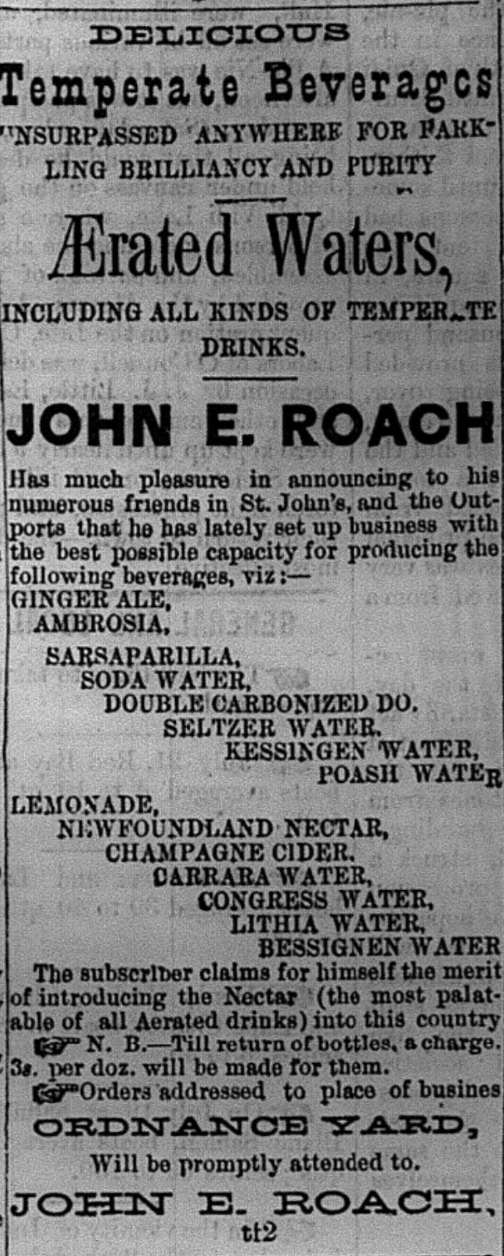
John E. Roach Ad, Terra Nova Advocate, Aug 11, 1875/ MUN DAI
Some of them were familiar to me: lemonade, ginger ale and soda water. Others I’d never heard of: Kessingen water, congress water and, most intriguing of all, something called Newfoundland Nectar.
I had no idea what Newfoundland Nectar was.
Naturally, I had to find out. So I dug further into the old papers.
I learned that Roach seemed particularly proud of his product. He described Nectar as the most palatable of all aerated drinks and claimed credit for introducing it to the country. And it appears to have caught on.
Later that year, a newspaper article specifically mentioned Nectar as an alternative to alcohol. And in a 1907 article reminiscing about life in 19th-century St. John’s, the author recalled the pleasures of Roach’s Nectar after a day of berry picking on White Hills.
In the years that followed Newfoundland Nectar wasn’t the only nectar on offer. As early as 1876, Roach seemed to have some competition The Mineral Water Co. of St. John’s was selling something they called ‘Aromatic Nectar,” and by the 1890s the Riverhead Brewery was advertising “Aerated Nectar”.
All of which was interesting, but it still left me with a fairly fundamental problem: I still had no idea what Newfoundland Nectar actually was.
I didn’t know what was in it. I didn’t know what it looked like. And I had no idea what it tasted like.
So I started assembling the clues.
The Clues
What did I know?
It seems to have been non-alcoholic.
It seems to have been sparkling.
It was sold in bottles.
It was popular enough to attract competitors.
Roach “introduced” it to the country.
That last clue seemed the most promising. If Roach had introduced Nectar to Newfoundland, then presumably he hadn’t invented the idea from scratch. The drink — or something sufficiently similar to it — must have existed somewhere else.
So, after all that digging through 19th-century newspapers and advertisements, I did what any curious reader of history would do.
I Googled it.
And that’s when I found nectar soda.
Nectar Soda?
In the 1870s, a beverage called Nectar Soda was becoming popular in the United States. It was described as a syrup made with milk, almond, vanilla and red food colouring, which was then diluted and carbonated. You can get a recipe for a homemade version here.
And a soft drink called Nectar Soda is still available through President’s Choice brand in Canada, which they describe as “a rich, dessert-inspired taste with a smooth sweetness and lively carbonation in every sip… Its distinctive flavour makes it a fun addition to celebrations, family gatherings, and everyday moments when you're craving something a little different.” The only flavour cues from PC are pictures of strawberries and bananas on the label.
And suddenly, I had some leads — was the 1870s American recipe the basis of Roach’s Newfoundland Nectar? Was it a soft drink with a vanilla flavour… some sort of cousin to cream soda? Was it something fruit-flavoured? Was it something else entirely?
Well, I still have no idea…
Either way, what I’m most curious about is, what made it Newfoundland Nectar? Did he alter the recipe? Was there some local ingredient or twist that made his version distinctive? Or was “Newfoundland” simply a bit of homegrown marketing that he attached to an imported soda?
I mean, it certainly sounds patriotic — although “Newfoundland Nectar” does make me picture a very large, very drooly dog, and that doesn’t exactly scream ‘refreshment.’ I digress.
Mystery
So, after spending far too much time digging, my historical side quest was a bit of a failure. While I learned a few things, Newfoundland Nectar is still a mystery to me.
But that’s the nature of these side quests. They rarely end in a neat and tidy package. Sometimes you find an answer; sometimes you find another question; and sometimes you just spend a day musing about what people were drinking in 1875.
But that’s what keeps writing Product of Newfoundland fun. I never know where the next question will lead me.
If you know what was in Newfoundland Nectar, or what it tasted like — I’d love to hear from you.
The comments are always open.
-
Aerated Waters, Terra Nova Advocate, August 2, 1876
The Man in Milwaukee, Newfoundland Trade Review, Sept 21, 1907.
The Chronicle Advises.., Morning Chronicle, Sept 23, 1875
Nectar Soda, Gastro Obscura