Charles MacKay and the Two-Year Iceberg

An iceberg off Salvage, NL
Icebergs off Newfoundland don't need the imagination of a storyteller to make them spectacular. They tower over the waves, drift close enough to shore to dominate the view, and seem to glow in the sunlight with pops of blue and green. They are truely impressive.
Just because icebergs don’t need any embellishment, hasn’t stopped people from trying and, when it came to iceberg tall tales one nineteenth century writer was in a league of his own.
Charles Mackay’s 2-year Iceberg
Scottish writer Charles Mackay published Under the Blue Sky in 1871. It was a collection of essays inspired by his observations of nature and everyday life. One essay, simply titled "Ice," includes a remarkable story from Newfoundland.
Now, he doesn’t give us any dates to work with, but Mackay reports an iceberg that grounded in St. John's Harbour "some years ago" and remained there for two full years. The heat of the short summers wasn’t “powerful enough to dissolve it.”
He estimated the iceberg stood more than 243m (800 ft) above the water. And, by his reckoning, roughly two-thirds of an iceberg lies beneath the surface, so he calculated its total height to be about 2,400 feet, or "about six times as high as St. Paul's."
A Tall Tale?
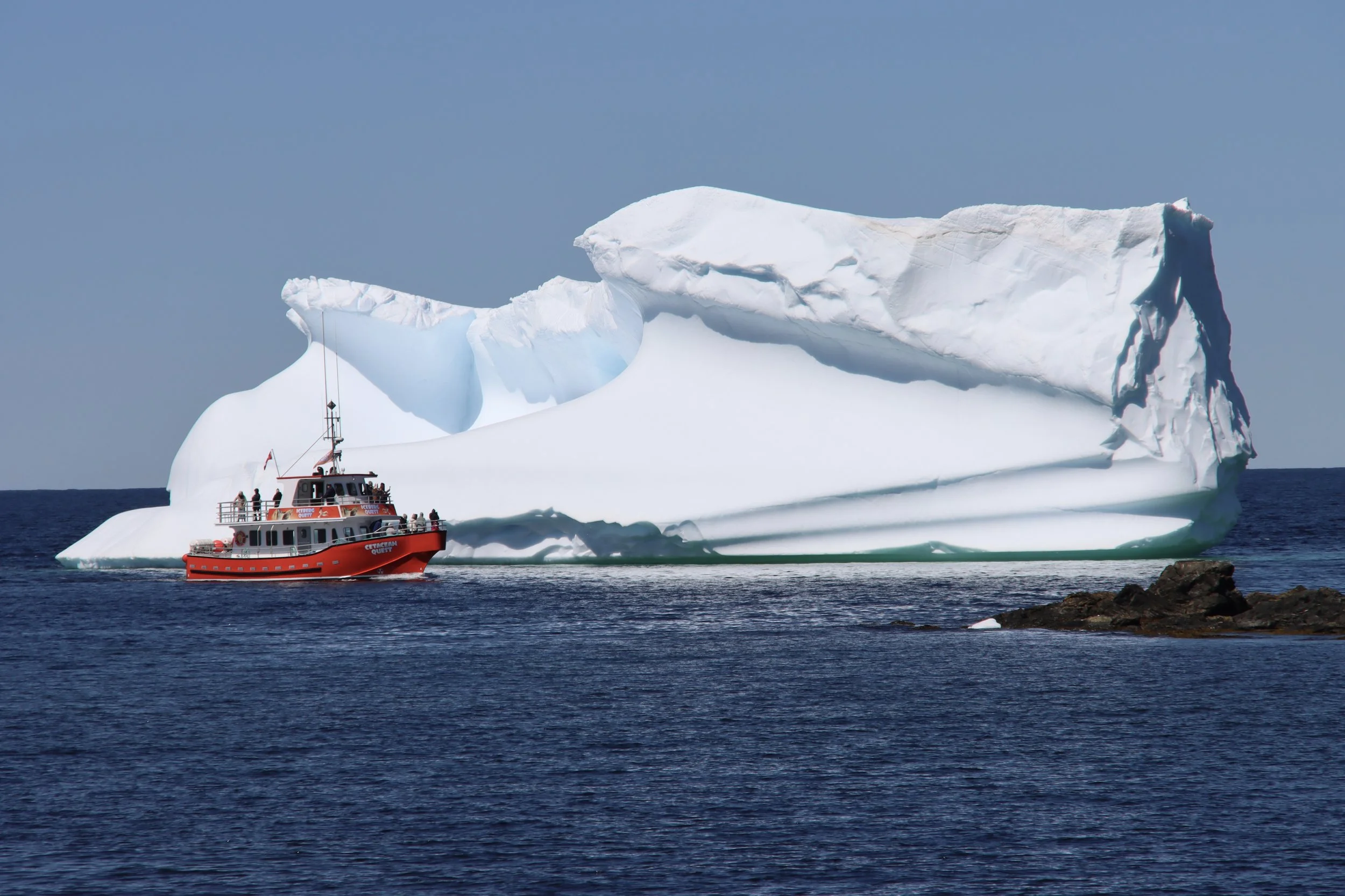
Iceberg off Twillingate, Newfoundland & Labrador
An iceberg 243m above the water... that sat in St. John's Harbour for two years?
That's quite a claim but nature is full of surprises. That said, I’m dubious and, as it turns out, I’m not the first person to suspect Charles Mackay had let his imagination come unmoored.
In September 1877, The Morning Chronicle published a letter from a reader in Salvage who politely —but effectively— skewered Mackay's story:
What a pity [Mackay] has failed to give the length and width of this extraordinary berg; it would have been so interesting to calculate the number of cubic inches it contained.
Is it to be wondered at that strangers avoid a coast around which such terrors as this are found prowling? The boundless misconception existing with regard to this island is not likely to be lessened, I imagine, while writers of Dr. Mackay's excellent scientific and philosophical standing continue to tell the world such tales.
In my very humble way, like Mark Twain, I admire science—it pays—"one gets such handsome returns of conjecture out of such a small investment of fact."
— F.J.J.S.
Victorian-era sarcasm? I enjoy it.
The Biggest Iceberg
Mackay's towering iceberg stretches believability to the limit of the Guinness Book of World Records and beyond. If it were real, his iceberg would be far taller than any ever reliably recorded in the North Atlantic.
The tallest known iceberg in the North Atlantic was spotted in 1957 by the icebreaker USCGC Eastwind in Melville Bay, Greenland. It rose about 168 metres (550 feet) above the water (almost exactly the height of Signal Hill in St. John’s).
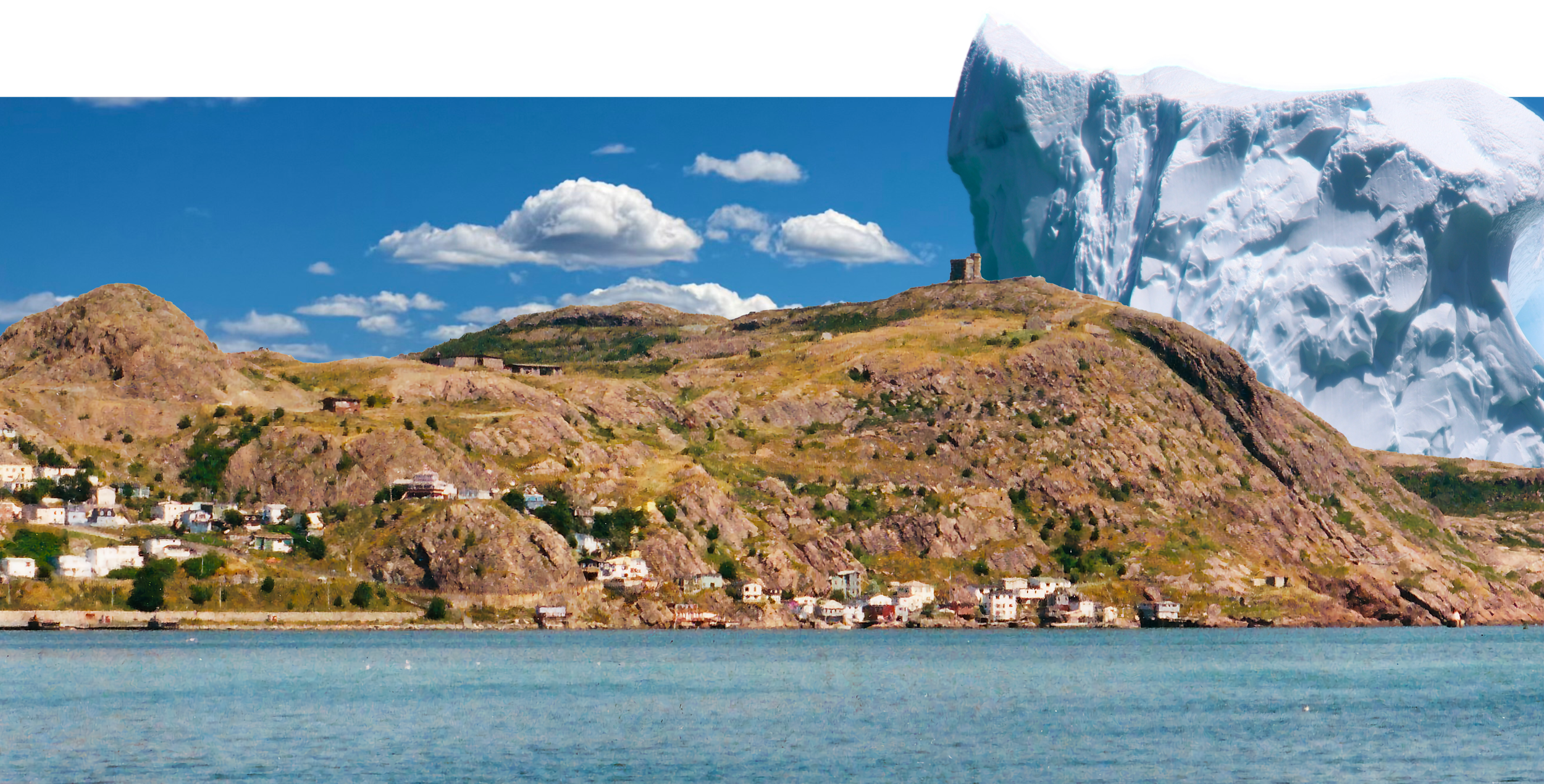
Signal Hill and the harbour in St. John’s, NL with an imaginary 800ft iceberg
The International Ice Patrol describes any iceberg rising 75 m (246 ft) above the water to be “very large,” and the one spotted in 1957 was more than twice that! You can see a picture of it here. It must have been an astonishing sight, and it still was only about two-thirds the height of the Mackay’s unbelievable berg!
It’s also worth remembering that the USCGC Eastwind berg was observed far north of Newfoundland. By the time an iceberg drifts south into Newfoundland waters, months of melting and erosion have usually reduced it considerably. So even this massive berg would have been smaller by the time it reached the island.
How Long Do Newfoundland Icebergs Last?
Speaking of melting and erosion, the two-year stay in St. John's Harbour is even harder to accept.
Once icebergs reach Newfoundland, they are already nearing the end of their journey. Their lifespan depends on ocean temperatures, wave action, winds, currents, and the time of year, but they don't normally linger for years.
Most icebergs arrive off Newfoundland in April and May, with the season typically winding down by late July or early August. Even in 1816 — the year without a summer — I can find no mention of remarkable or long-lasting icebergs in or near St. John’s.
So, I think the idea of an iceberg surviving in St. John's Harbour through two summers belongs firmly in the realm of storytelling rather than science.
-
Under The Blue Sky, Charles Mackay, 1871
A Middling Sized Iceberg, Morning Chronicle, Sept 25, 1877
A Complete Guide to Icebergs in Newfoundland & Labrador, Newfoundland & Labrador
Charles Mackay , Pan Macmillan