The Captain, the Bear, and the Sea Serpent
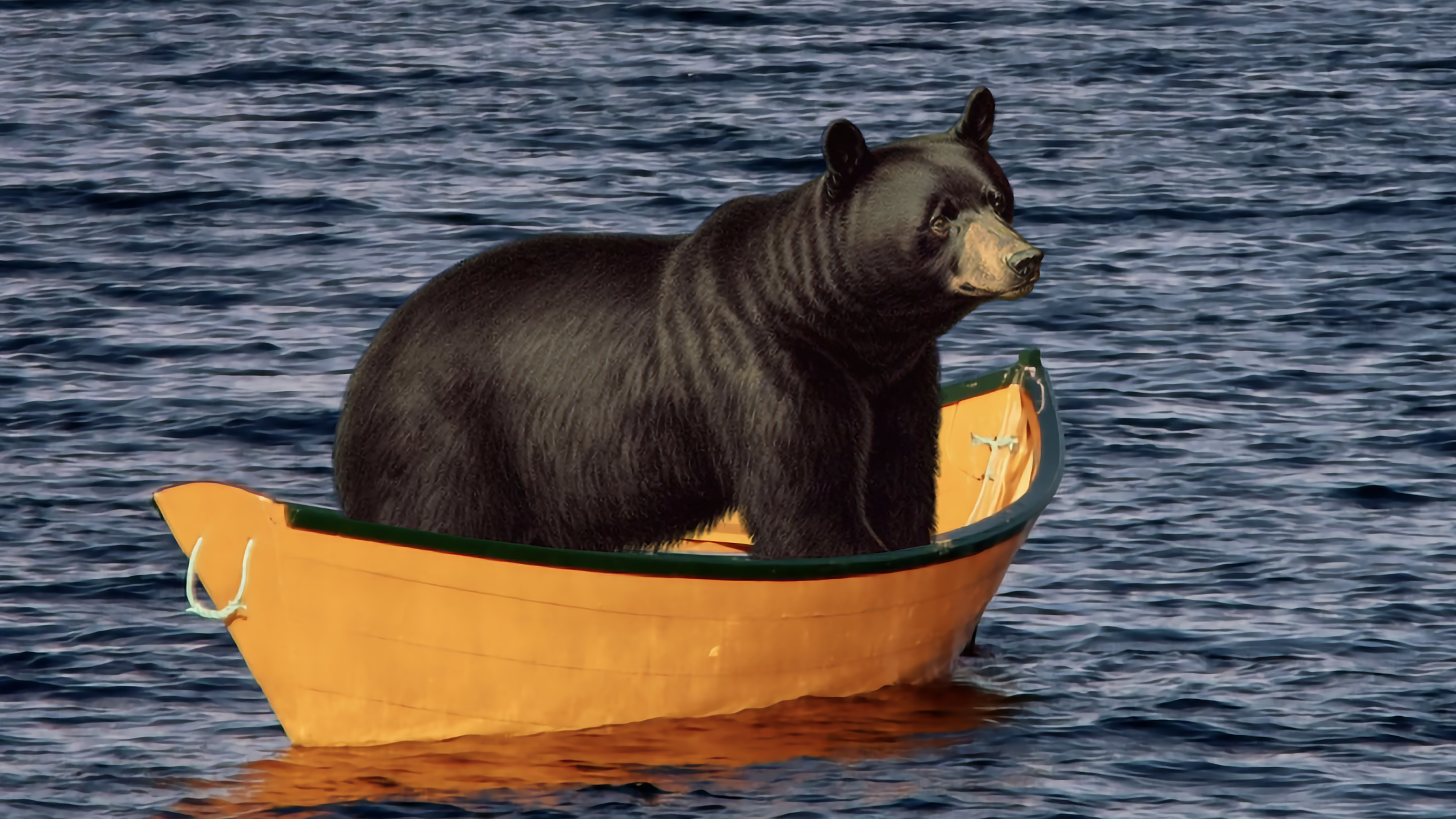
Most Newfoundland schooner captains spent their days worrying about storms, icebergs, and cod catches. Captain James Walsh of River Head, Conception Bay seemed to have stranger concerns — a bear in the belly of his boat, for instance, and even a glowing sea serpent. Both figure into his story, but neither was his real problem.
Captain Walsh's real problem was the local newspapers.
A Bear In The Belly of the Boat
I discovered James Walsh by accident while browsing an 1877 edition of the Morning Chronicle. I first met him in a letter submitted to the St. John's newspaper — a letter that, as I would later discover, had also been sent to other papers around the island.
It began:
Dear Editor,
By the arrival of the schooner Fox, Capt. Walsh, from northern Labrador, we have been put in possession of a wonderful species of Bear, captured by the said Captain and his crew on a small Island near Cape Mugford.
The animal has been brought home alive.
I have been requested to write a description of it for the press, which I have much pleasure in doing
By then, there was no turning back. I needed to know more.
The animal described was a striking specimen. It measured, from the tip of its nose to the end of its tail, nine feet and four inches long. It was covered in jet black fur, with short and drooping ears, and a large “pulvous” brow. I don’t know what pulvous means, and the dictionary was no help. Could the writer have meant fulvous, as in tawny-coloured? Was he describing a black bear with a tawny brow? If so, that still wouldn’t have been its most remarkable feature — that distinction belonged to its feet. The bear was said to have six toes on each foot.
However interesting the animal looked, the tale of its capture was stranger still.
As the Fox, Walsh’s schooner, was passing by a small Island, some of the crew noticed a large animal pacing to-and-fro in a gulch at the waters edge. Their curiosity piqued, they decided to get a closer look.
They lowered a punt, and five crewmen — supplied with only a gun, pews, and rope — began rowing toward shore. As they neared the coast they realized they were looking at a huge bear. The animal seemed to return their interest, rising on its hind legs, peering toward the approaching crew.
They considered shooting the animal and bringing the carcuss back to the boat but, they reasoned, if a dead specimen was good, wouldn’t a live specimen be that much better? So they decided the best course of action was to lasso the beast and take him alive.
As the tale goes, they rowed close enough to toss a rope around the bear’s neck, then began rowing away from shore, drawing the animal into the ocean. They kept it swimming until exhaustion set in, they drew closer and tightened the rope around its neck until it neared the point of strangulation. At that point they were —somehow— able to hoist the enormous beast aboard the punt, and from there to the schooner.
The animal was moved to the hold. Sadly, the means by which this feat was accomplished are left to our imagination. But once the bear was situated, the ropes were cut and he “displayed wonderful indifference.”
It was such a remarkable specimen that the writer felt it might be worthy the attention of naturalists who might make arrangements to have the animal sent to the Zoological Gardens in England.
The bear, in due course, made its way back to port in Harbour Grace, where the writer invited townspeople to visit Capt. Walsh's schooner to see the bear for themselves.
The piece concluded with an invitation:
The utmost curiosity is at present manifested by all our towns-people to visit Capt. Walsh's craft, and have a peep at this wonderful inhabitant of the northern regions.
Thanking you, Mr. Editor for your valuable space, I am, &c.,
Yours,
H. L. C.
The letter ran in the Morning Chronicle and the Public Ledger on October 23, 1877, and I’m sure it caught the attention of many readers. It was, after all, a fantastic tale; one that aligned with the adventurous tales of Arctic explorers that were popular in the era.
It was, unfortunately, a complete fabrication.
Setting The Record Straight
On October 27, the Harbor Grace Standard countered the tale:
We beg here to state that the Fox, Mr. Walsh's schooner, had not arrived in port at the time the above communication was dated that she did neither see, capture, receive on board, nor convey hither, any bear small or large, and that consequently "the utmost curiosity" is not "being manifested by our townspeople…”
None of it happened. There was no bear, six-toed or otherwise. The writer, H.L.C. had invented the entire episode. And that might have been the end of the tale but for one other revelation, via the Standard:
The joke — if such a heartless deception can be called joke — is rendered doubly atrocious from the fact of its being perpetrated on Walsh, of River Head, the victim last year of a similar trick.
If this was the second fabricated adventure bearing his name, it seems the hoax wasn't aimed at fooling readers, as much as it was targeting James Walsh.
A Glowing Sea Serpent
On November 25, 1876, not quite a year before the bear debacle, a letter appeared in the Times And General Commercial Gazette, purportedly written by Walsh, himself concerning a voyage aboard the Zebra.
It began:
Sir,
Having recently returned from. Labrador, the seat of my Summer avocations, I wish to lay before your readers, and the people of St. John's, through the medium of your journal, & short account of an adventure which my crew and myself experienced on our voyage to the Labrador coast the past season.
The following will, perhaps, be more particularly interesting to those possessed of a scientific or reflecting turn of mind.
What followed was nothing short of a terrifying tale.
At 3 p.m. on June 12, 1876, Captain Walsh's schooner was bound for Labrador. About ten miles off Baccalieu Island, one of the crew spotted a large black object floating on the sea. The moment he pointed it out, it vanished.
The crew kept their eyes fixed on the spot for some time, but nothing more appeared. Just as they began to wonder if the sighting had been a trick of the light, the object surfaced again.
This time, however, it was no longer merely floating.
Whatever it was, it was alive.
The creature rose ten or twelve feet above the water, revealing what the letter described as a truly horrifying sight:
[T]he head appeared to be like a horse's, but much larger; the eyes projecting out from the forehead, like large bags or pouches, of a dull whitish colour.
As if that weren't unsettling enough, the writer claimed that two horns, each extending two or three feet from its nostrils, completed the monstrous appearance.
After about 2 minutes, the creature submerged, and for two hours nothing more was seen of it until it was glimpsed in the wake of the schooner.
At midnight it made another appearance, as ‘Walsh’ put it:
I descried, about a fourth of a mile from us, a bright phosphorus train shooting rapidly across our track ahead. We continued on our course, — this moving train of light coming nearer and nearer. We were actually stupified with fear.
When the object was within about 30 yards of our bows a tremendous shower of water, all alive with phosphorus, shot up into the air a distance of at least twenty yards, lightning everything around.
In a short time nothing unusual was visible; — we continued on our course all that night, and saw nothing more of this wonderful animal.
The letter ended with the writer hoping that some reader might be able to identify the creature’s whereabouts and habits, and a bit of a confession:
I hope never to experience the same dreadful fright again,
Yours truly,
James Walsh.
Though originally printed, as if genuinely written by Walsh, a year later it was being described as a joke perpetrated on him.
If the anonymous author had been looking for a laugh, they got one. For nearly a year, Captain Walsh's imaginary sea serpent seemed to surface wherever newspapers were read. And if the editors enjoyed poking fun at him in print, you can imagine what happened once the papers reached the wharves. Around the stagehead, where stories have always grown a little taller with telling, Walsh's mythical encounter was probably recounted with much enthusiasm, teasing, and laughter.
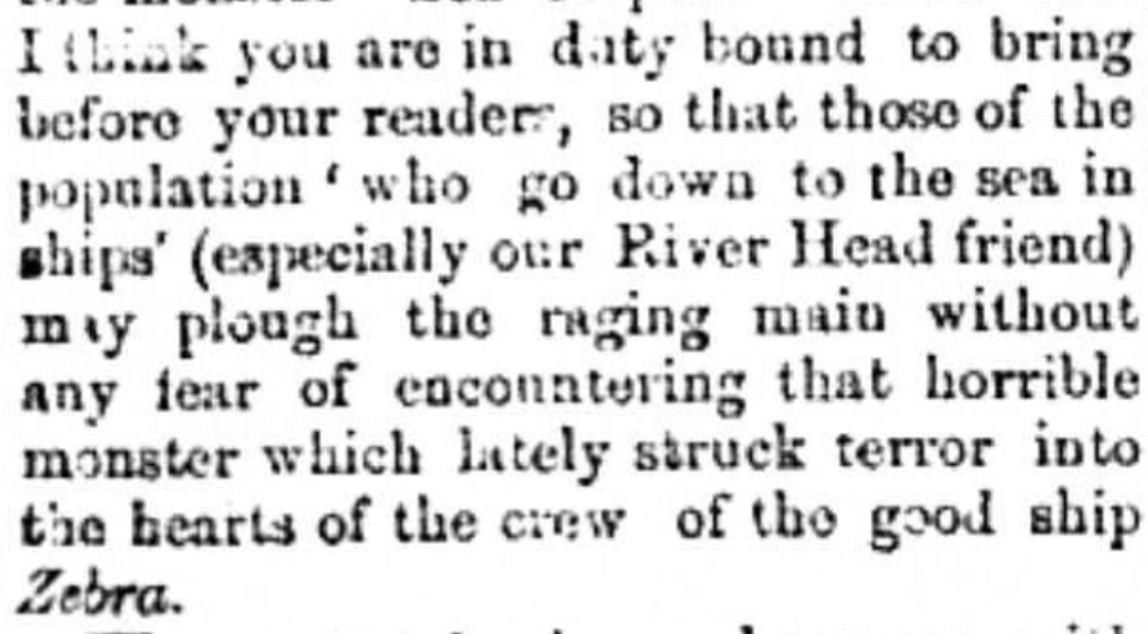
Excerpt from A Clue to the Great Sea Serpent, Harbor Grace Standard, Sept. 8, 1977
The Unwilling Hero of Two Tall Tales
Unfortunately, this story doesn’t end in a neat and tidy package.
I can’t tell you who wrote the letters. I don't know why James Walsh was singled out, or whether he ever discovered who was behind the prank.
What I am sure of is that somebody, somewhere, took the time to invent two extraordinary adventures for a seemingly ordinary Newfoundland schooner captain — and somehow managed to convince multiple newspapers to print them as fact.
If storms, icebergs, and cod catches were the usual concerns of schooner captains, then Walsh’s problems were something stranger: not the sea itself, but the stories told about it.
I don’t know if the whole episode turned out as the prankster would have hoped. After all, whoever invented Captain Walsh's adventures has been forgotten, and Captain Walsh, who never lived them, is the one we're still talking about.
-
A Bear Story, Morning Chronicle, Oct 23, 1877
To The Editor, Public Ledger, October 23, 1877
Bear Captured, North Star, October 27, 1877
We beg to inform…, Harbor Grace Standard, November 17, 1877
The Sea Serpent Again, The Advocate, Sept 25, 1978
Our Old Friend, Harbor Grace Standard, June 2, 1877
To The Editor, Times and Commercial Gazette, Nov 25, 1876
A Clue to the Great Sea Serpent, Harbor Grace Standard, Sept. 8, 1977
The Sea-Serpent Again, Harbor Grace Standard, July 14, 1877
Truth Stranger Than Fiction, Harbor Grace Standard, December 02, 1876