For more than a century people have been telling the tale of strange night in Holyrood, NL. A night when they heard something familiar, something welcome, that quickly turned into a waking nightmare.
The story has appeared repeatedly in Newfoundland newspapers, Christmas annuals and books. The details change with each telling — even the year is disputed — but the story always begins the same: with a schooner, a storm, and a dark October night.
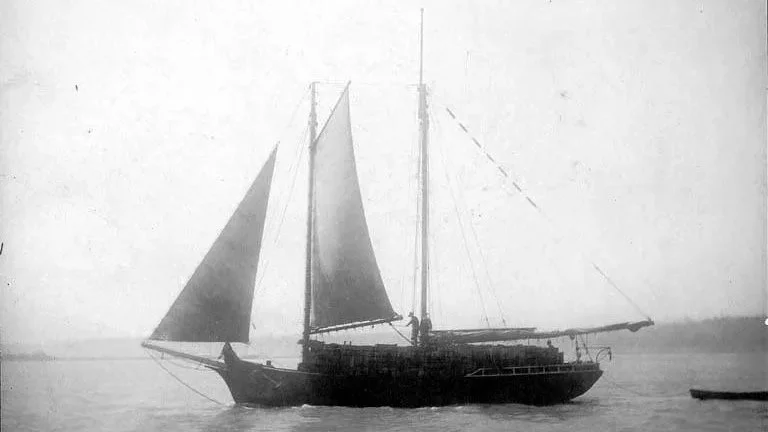
Unidentified schooner, Wilhelm Hester, Public domain, via Wikimedia Commons
A Terrible Storm
A violent gale was battering the northeast coast of Newfoundland. The wind whipped across the waves, carrying spray far into the night and somewhere in the storm was the Isle of Skye.
The schooner had left Holyrood in June, and now, after a summer off the Labrador coast, her crew of ten men and two women were making their way home.
But Holyrood was still a long way away, and the Isle of Skye was off course. The skipper didn’t know exactly where they were — somewhere in Notre Dame Bay, but whether they had cleared Twillingate or even Fogo, he couldn’t say. The storm had blotted out the sky and swallowed every landmark. Worse still there was little chance of spotting any breakers until the schooner was on top of them.
All hands kept watch, praying they could keep the boat off the rocks.
Holyrood
Holyrood lay well to the south but the storm was making itself known there, too. The wind was stripping leaves from the trees and throwing waves high onto the shore.
Now you have to remember, in the latter half of the 19th century, when our story takes place, things were different. Nights were blacker and shadows could only be pushed back as far as the glow of the oil lamp allowed. And coves were quieter, too. There were no cars, motors or phones to fill the silence. In fact the world was silent enough that many people drifted to sleep hearing only the sounds of the wind and water.
By 10 o’clock many houses in Holyrood were dark, they had douted their lamps and were lying in bed, bundled under heavy quilts when they heard it — from outside came the sound of sails flapping in the wind, and men calling to each other.
It was the familiar sound of a boat approaching shore, and her crew were getting ready to anchor.
The arrival of a schooner was always exciting, but in October it was especially so. It was bound to be a crew back from the Labrador fishery — carrying family that had been away for months. Kitchen tables that had been missing loved ones could once again be filled, and if the news of the fishery was good, their earnings could keep that table well provisioned for the winter, too.
Dennis Penny hopped from bed, dressed and threw another junk of wood in the stove. If there was a schooner in the cove, it must be the Isle of Skye — and with her, his son!
It would be good to see the boy again: to sit together, have a cup of tea in the lamplight, and hear all about his summer on the Labrador.
He pulled on his boots and headed for the wharf. In the darkness he could see the lanterns of a small crowd already assembled by the wharf.
“Breakers Ahead!”
As they waited, the voices of the approaching crew grew clearer, they no longer sounded like they were preparing the anchor. They seemed to be in turmoil, like they were yelling to each other.
From the wharf they looked toward the sound, to where — out in the darkness — a ship would soon emerge.
The voices carried over the waves growing more agitated, more urgent, until one phrase rang out above the rest:
“Look out! Breakers ahead!”
Then nothing. Dead silence.
The people of Holyrood stood waiting, their eyes trained on the harbour, looking for some sign, some indication of a crew needing help but there was nothing, only the sounds of the sea in an empty harbour.
There was no schooner in the cove, at least not anymore.
Perhaps if only one of them had heard it, they could have believed it was imagination but they’d all heard it…
The horrible truth washed over them: for a few short minutes the Isle of Skye, or some shadow of her, had been there —back at home— but unless they were gravely mistaken, she never would be again.
Wherever she was now, she was beyond the reach of the living.
The Awful Truth
Soon enough their fears were confirmed. En route from Labrador the Isle of Skye and her entire crew had been lost.
She was last seen crossing Notre Dame Bay on October 10th, and presumed lost in a terrible storm that had swept through the area on the 11th. Her wreckage was discovered near Moreton’s Harbour.
For years afterwards, the people of Holyrood remained convinced that the crew of the Isle of Skye, made it home, for one brief stop on their journey between this world and the next.
An Addendum
In 1921, shortly after a version of the tale written by H.F. Shortis appeared in print, a writer credited as W. B. J. wrote to the Evening Advocate with an addendum to the tale.
The writer said that, as a child, he lived in Western Head Harbour, Notre Dame Bay and recalled being told that one night in October 1865, about midnight, a girl who was sitting up with a sick woman. She went outdoors and heard voices carried on the wind. They were coming from the sea, and they were “shrieking in peril.”
She didn’t speak of it, the writer tells us, until a few pieces of wreckage and personal articles were picked up on the shore.
One seaman's chest, he wrote, was the only means of identifying the wreck. It took several months before the news came and went from Holyrood to Western Head to confirm that it belonged to the Isle of Skye.
In Western Head, not too far from Moreton’s Harbour, they believed the schooner had attempted to sail toward Whale Gulch —a small, protected harbour nearby — but the skipper mistook the light at Western Head Harbour, as his destination and ran upon the rocks, only to sink in about forty fathoms water, just off shore.
For years, men had fished those waters without any particular trouble but after that October gale their nets began catching on something deep below. Their gear got tangled, torn and sometimes lost altogether. They came to believe they were snagging the remains of the wreck — a suspicion strengthened when a human leg bone and a jaw were recovered from the area.
The writer goes on to say that, legends of noises and lights emanating from the site before storms were talked about for years.
He concludes his piece with the following:
On that day "when the sea shall give up its dead" we shall learn the details of the loss of the "Isle of Skye" but I venture to claim from the evidence produced conclusive proof of the spot where these poor souls met with a watery grave.
Yours truly,
W. B. J.
St. John's, Dec. 28, 1921.
Whether you take the account of W.B.J. — or any aspect of the legend of the Isle of Skye as factual — is, of course, up to you.
Like the best ghost stories, it lives on the edge of doubt… there aren’t a lot of facts to back it up. Still, it leaves you something to consider on a blustery October night.
Listen
Listen to the story of the Isle of Skye as part of the Strange Truths and Tall Tales podcast episode The Future Imperfect.
-
Fireside Stories, H.F. Shortis, Newfoundland Weekly, December 20, 1930
A Phantom Ship, The Right Honourable Lord Morris, Privy Councillor, The Newfoundland Illustrated Tribune, Christmas Number, 1918
Offbeat History, Evening Telegram, Nov 13, 1959
Loss of the Isle of Skye, Evening Advocate, December 29, 1921





It was well after dark but it certainly sounded like a schooner was coming into the harbour. The people of Holyrood rushed to the shore, what they found —or more importantly —didn’t find, has kept this story alive for more than a century.