Sir Humphrey Gilbert and the Lion
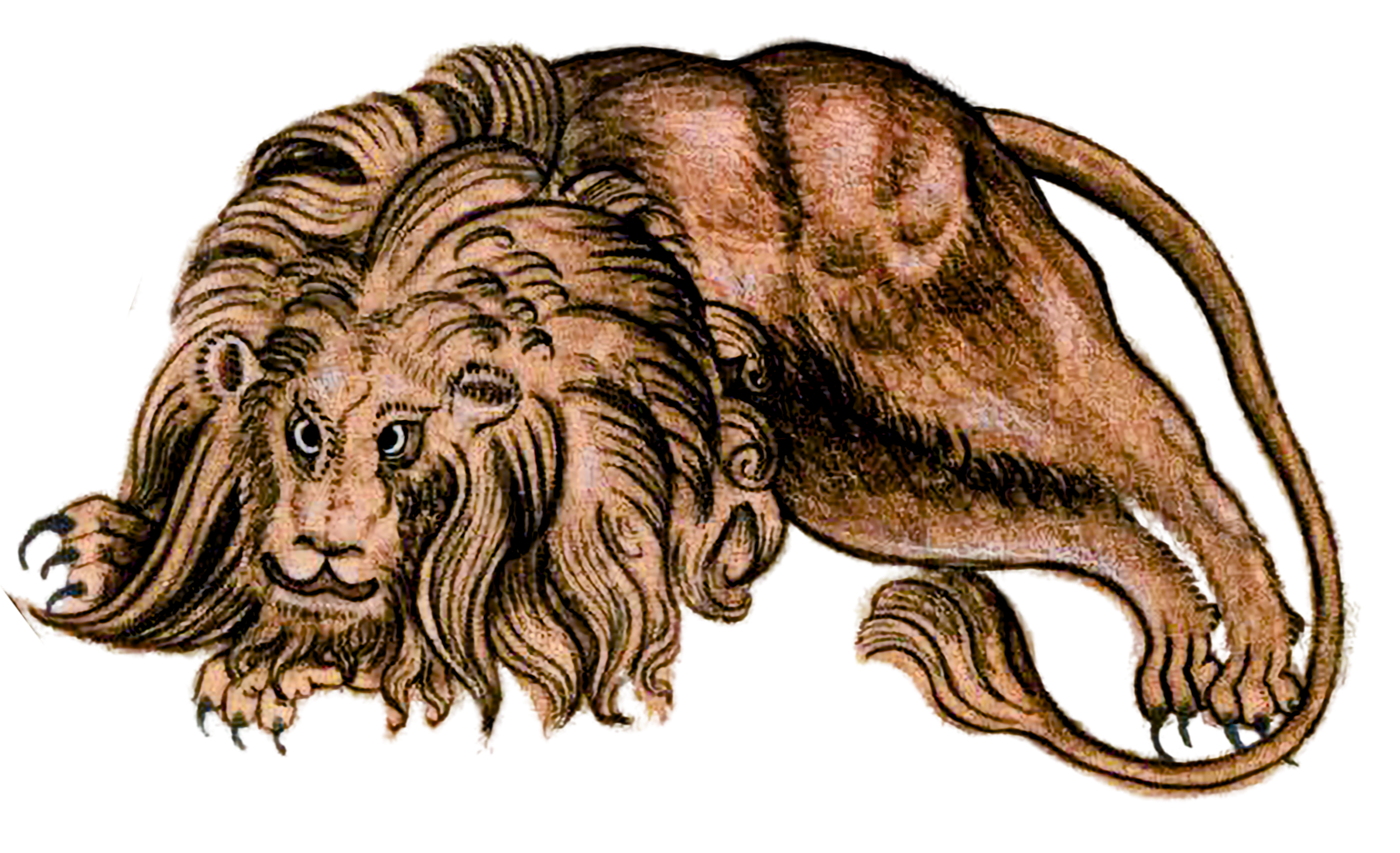
A depiction of a lion from the Tudor period, Wikimedia, public domain
If you spend enough time at sea, you’re bound to see strange things—especially if you’re sailing beyond the edges of your known world. It’s the perfect set of circumstances for thrilling, unnerving, and, at times, deeply confusing adventures.
The early colonial travellers to Newfoundland knew the feeling well, and they had some truly remarkable strange encounters.
Sir Richard Whitbourne believed he spotted a blue-haired mermaid in St. John’s harbour. And Sir Humphrey Gilbert?
Well, he didn’t see a mermaid but he encountered something else he couldn’t explain — a lion… in the open ocean.
Sir Humphrey Gilbert
Sir Humphrey Gilbert was many things — a soldier, Member of Parliament, and an ambitious Tudor adventurer — but above all, he was a man determined to carve out a place in the world for himself.
In 1578, Queen Elizabeth I granted him permission to seek out and establish an English colony overseas. For Gilbert, it was more than duty to the Crown. As a second son, he stood to inherit little from his family. If he wanted land, status, and legacy, he would have to find them elsewhere, and North America seemed just the place to do it.
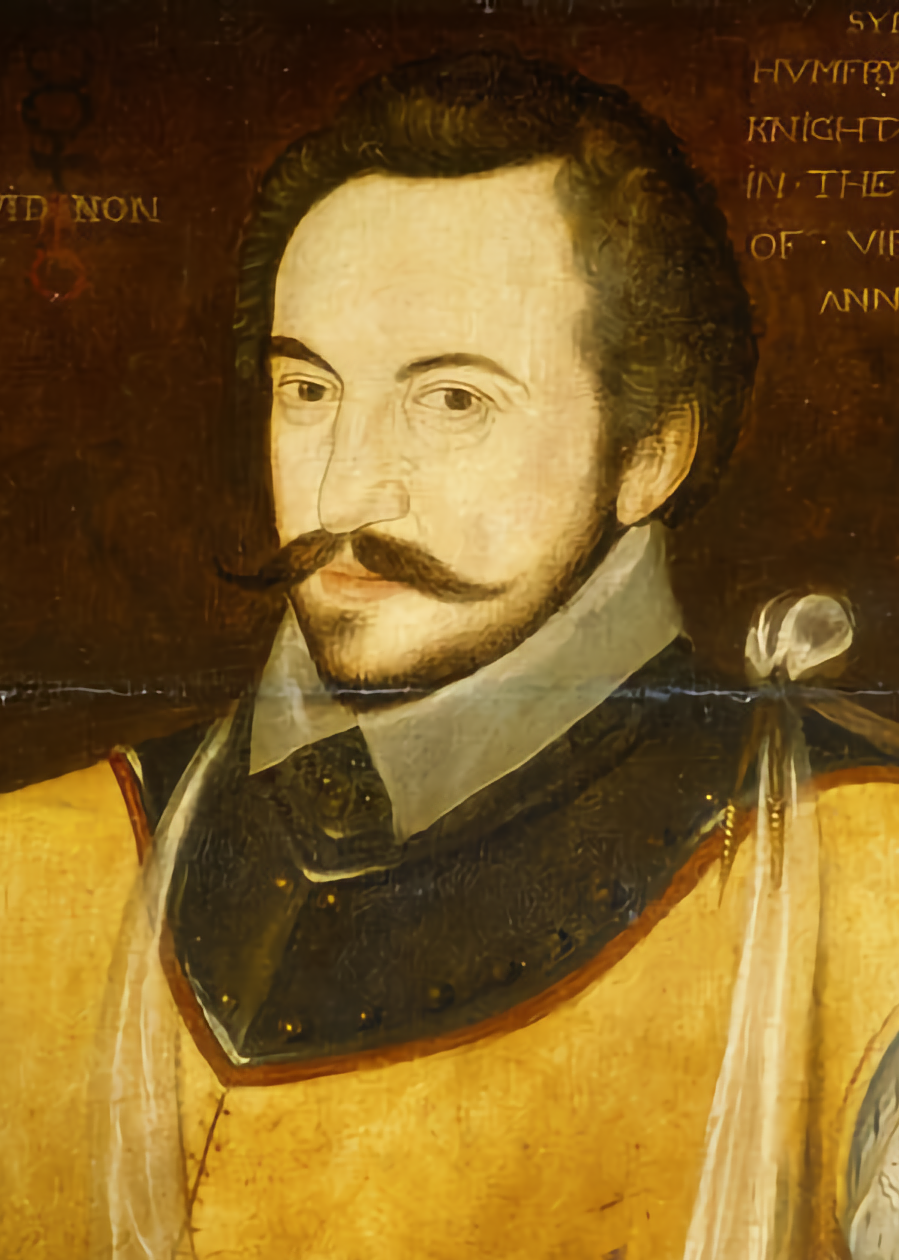
Sir Humphrey Gilbert, Public domain, via Wikimedia Commons
So he gathered men, scraped together a convoy of ships, and in November set sail with a fleet of ten boats toward Newfoundland. The venture unraveled almost immediately.
Finding skilled sailors had been tough, so Gilbert resorted to filling his crews with pirates — men who proved difficult to command. Before long, four ships broke away from the convoy to chase prizes of their own. Two more boats began to take on water and turned back for England. The rest never made it to Newfoundland. The voyage ended in embarrassment, leaving Gilbert financially ruined.
For many, that would have been the end of it. Not for Gilbert.
He began again. Carrying on, despite failure and the significant doubts swirling around him. Even Queen Elizabeth I is said to have remarked that he was “noted of not good happ by sea.”
Despite the doubts, in 1583 he sailed again — this time with five ships. Once again, it was rough start. One vessel, commanded by his half-brother Walter Raleigh, turned back early in the voyage. The rest kept on, westward across the Atlantic.
The voyage took longer than expected, and supplies began to run low but, in early August, they finally sighted the island.
Newfoundland was, of course, no untouched wilderness. Indigenous peoples had lived there for thousands of years, and by the late 1500s, even European fishing fleets were working its waters. St. John’s harbour, in particular, was busy and crowded with fishing enterprises.
The people in St. John’s had learned to become wary of visitors — pirates were a real threat. So when Gilbert’s convoy approached, it didn’t receive a warm welcome — it was stopped.
Word spread quickly among the fishing captains that one of Gilbert’s men was a pirate who had preyed on Portuguese ships in the harbour the season before. St. John’s was not eager to welcome him back. The tension climbed as crews gathered, watching and waiting.
The success of the entire venture rested on Gilbert’s ability as a diplomat. He stepped forward and made his case — that he sailed under royal authority, and that he came not as a raider, but as a representative of the English Crown — and It worked. The crowd relented and he was granted access to the harbour.
Claiming Newfoundland
Gilbert wasted little time. He and his crew came ashore, drove stakes and raised a tent. The set about making preparations for a piece of political theatre that must have furrowed the brow of more than one person in attendance.
On August 5th, with much fanfare, he summoned the fishermen and merchants of the harbour to Admiral’s Beach — near what is now Harbourside Park — and there, before a mix of nationalities made his claim: In the name of Queen Elizabeth I, he declared Newfoundland English territory, to be held in perpetuity.
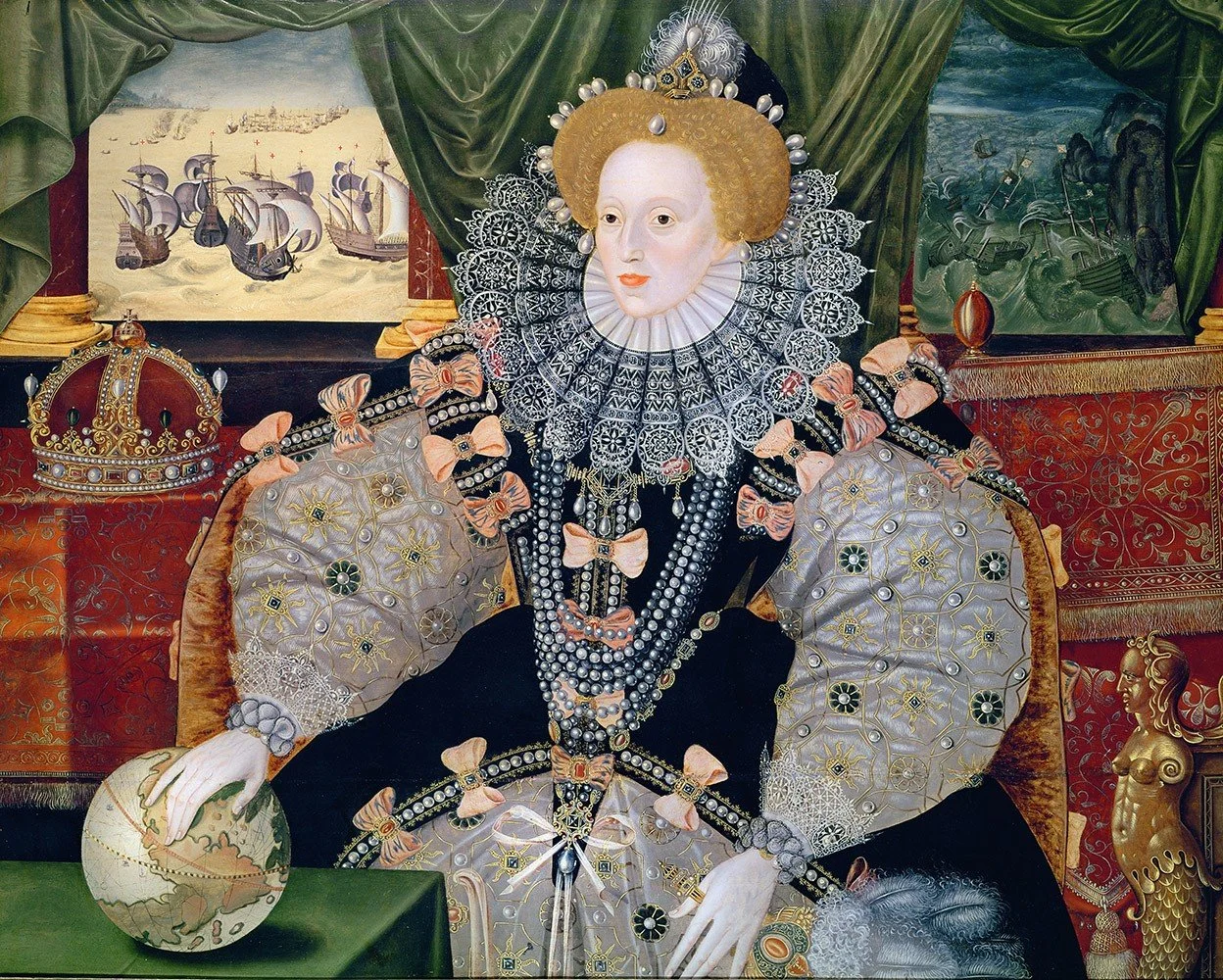
Portrait of Elizabeth I of England, the Armada Portrait, Wikimedia, Public domain
With the declaration came new rules. To each of the 36 vessels in the harbour he issued a certificate granting it permission it to continue fishing — as they had been doing all along. He made the Church of England the religion of the land, and forbade anyone from disrespecting to the queen (on pain of ‘cutting of ears’).
He erected a formal marker, bearing the royal coat of arms, to remind all of the new arrangement.
With the ceremony behind them, one of Gilbert’s crews returned to England. The remaining three boat — Delight, Golden Hind, and Squirrel — set their sails for the south, intent on pushing further along the edge of North America.
They didn’t get far.
Near Sable Island, the weather turned. A wind rose suddenly, driving the ships toward the shoals. The Delight struck It was torn apart by the surf. Only fifteen men were pulled from the wreck.
It was a crushing loss. Their already depleted supplies took another hit, and their confidence was shaken. Whatever momentum they had carried from their proclamation in St. John’s, seemed to drain away.
On August 31st, the decision was made: they would turn back.
It was then they saw the lion.
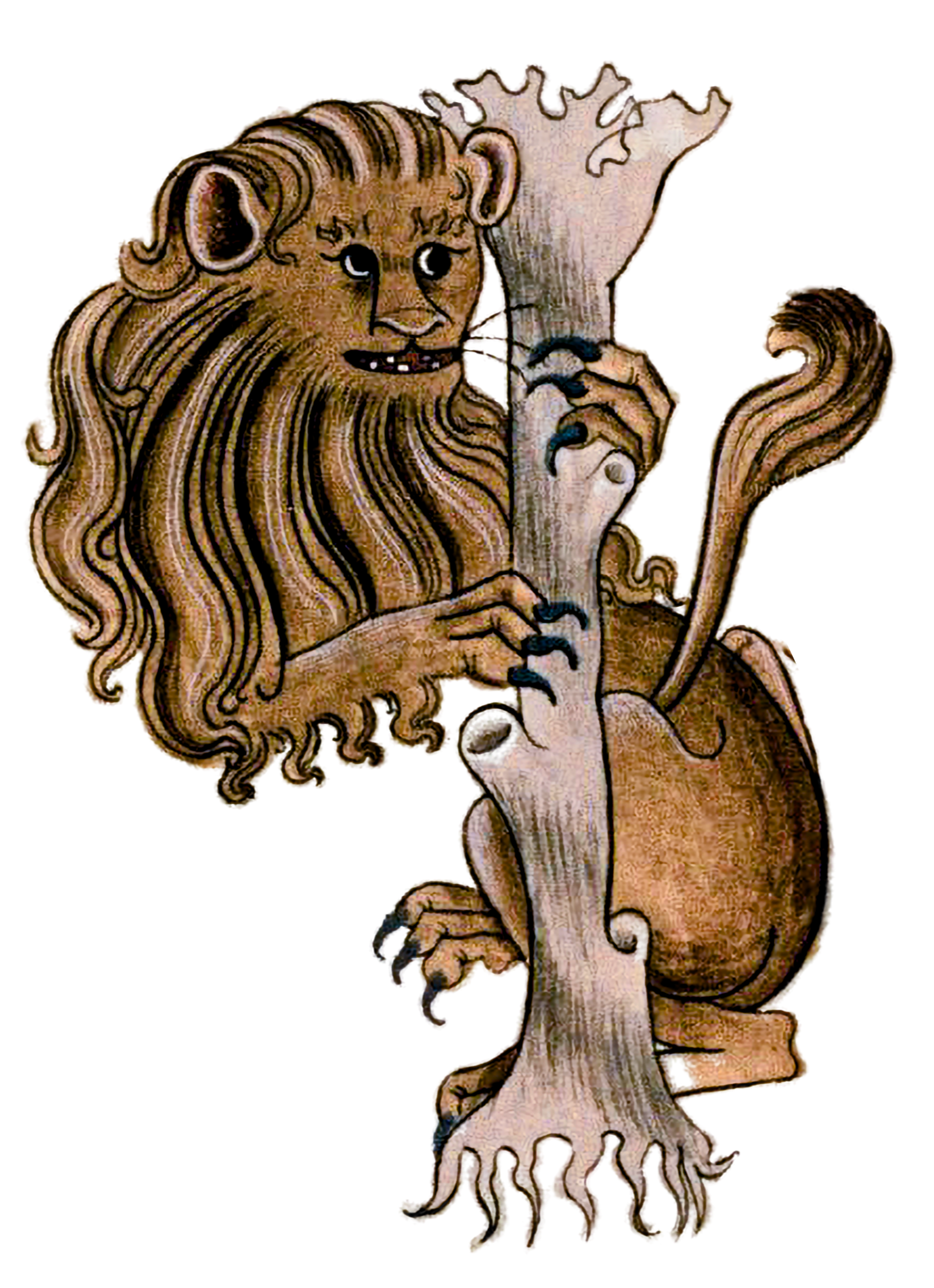
A depiction of a lion from the Tudor period, Wikimedia, public domain
Sir Humphrey Gilbert’s Sea Monster
The account comes to us through Edward Haies, who kept a careful journal of the voyage:
On Saturday afternoon we changed course and headed back for England. At that very moment, as we were turning, something passed between us and the land we were leaving behind—a creature that looked, to us, exactly like a lion in shape, mane, and colour.
It did not swim the way a normal animal would, moving its legs. Instead, it seemed to glide across the surface of the water, its whole body visible except for the legs. Nor did it dive and rise again like whales, dolphins, tuna, or porpoises. It stayed above the water the entire time, clearly in view.
As it moved past, it turned its head from side to side, yawning and opening its mouth wide, showing long, ugly teeth and glaring eyes.
Then, as if to bid us farewell, it came directly toward the Hind and let out a terrible sound — a roar or bellow like that of a lion.
We all watched it as long as we could see it, amazed at the sight — for it was a strange thing indeed: a lion in the open ocean.
-
Above I’ve retold Haies story in modern English. The following is the text as written by Haies:
“So upon Saturday in the afternoon, the 31 of August, we changed our course, and returned back for England. At which very instant, even in winding about, there passed along between us and towards the land which we now forsook a very lion to our seeming, in shape, hair, and colour, not swimming after the manner of a beast by moving of his feet, but rather sliding upon the water with his whole body, excepting the legs, in sight, neither yet diving under, and again rising above the water, as the manner is of whales, dolphins, tunnies, porpoises, and all other fish: but confidently showing himself above water without hiding … he passed along turning his head to and fro, yawing and gaping wide, with ugly demonstration of long teeth, and glaring eyes; and to bid us a farewell, coming right against the Hind, he sent forth a horrible voice, roaring or bellowing as doth a lion, which spectacle we all beheld so far as we were able to discern the same, as men prone to wonder at every strange thing, as this doubtless was, to see a lion in the ocean sea, or fish in shape of a lion.”
Gilbert took the sighting to be an auspicious sign.
Two days later they passed Cape Race, on the coast of Newfoundland and from there they travelled into the open Atlantic.
As Near To Heaven By Sea
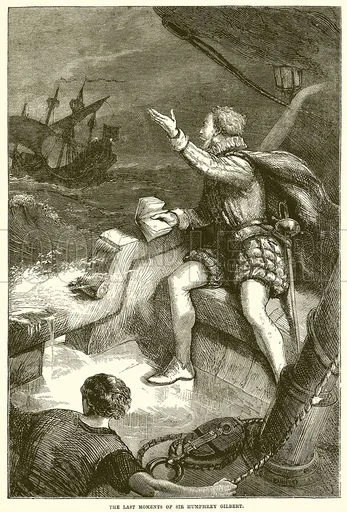
Last moments of Humphrey Gilbert, antique print c1880, Public domain, via Wikimedia Commons
It was the last voyage Sir Humphrey Gilbert would ever make.
On September 9th, he was aboard the Squirrel, the smaller of the two boats. He was seen sitting in the stern of the boat, reading a book. The sea wasn’t good, and the crew of the larger Golden Hind urged him to join their vessel but he declined, uttering his famous, last recorded words, “We are as near to Heaven by sea as by land!"
That night, from the deck of the Golden Hind, men watched the Squirrel rise and fall against the swell, its lanterns flickering in and out of view — there one moment, and gone the next.
Then, all at once, the lights vanished.
She had gone down with all hands; and Sir Humphrey Gilbert was dead.
What Did They See?
So what did Sir Humphrey Gilbert see? Was it really a lion gliding across the surface of the Atlantic?
Probably not.
Most people think that the crew witnessed a walrus, which may seem like an odd suggestion in the 21st century, but it wasn’t such a long shot in the 1500s.
The Atlantic walrus once called Sable Island home and was seen l along the shores of Nova Scotia, Newfoundland, and the Gulf of St. Lawrence. Walrus remains were found in Port au Choix, at a site occupied by the Groswater Dorset more than 2000 years ago.
While they may have frequented the island in the past, it isn’t that way anymore.
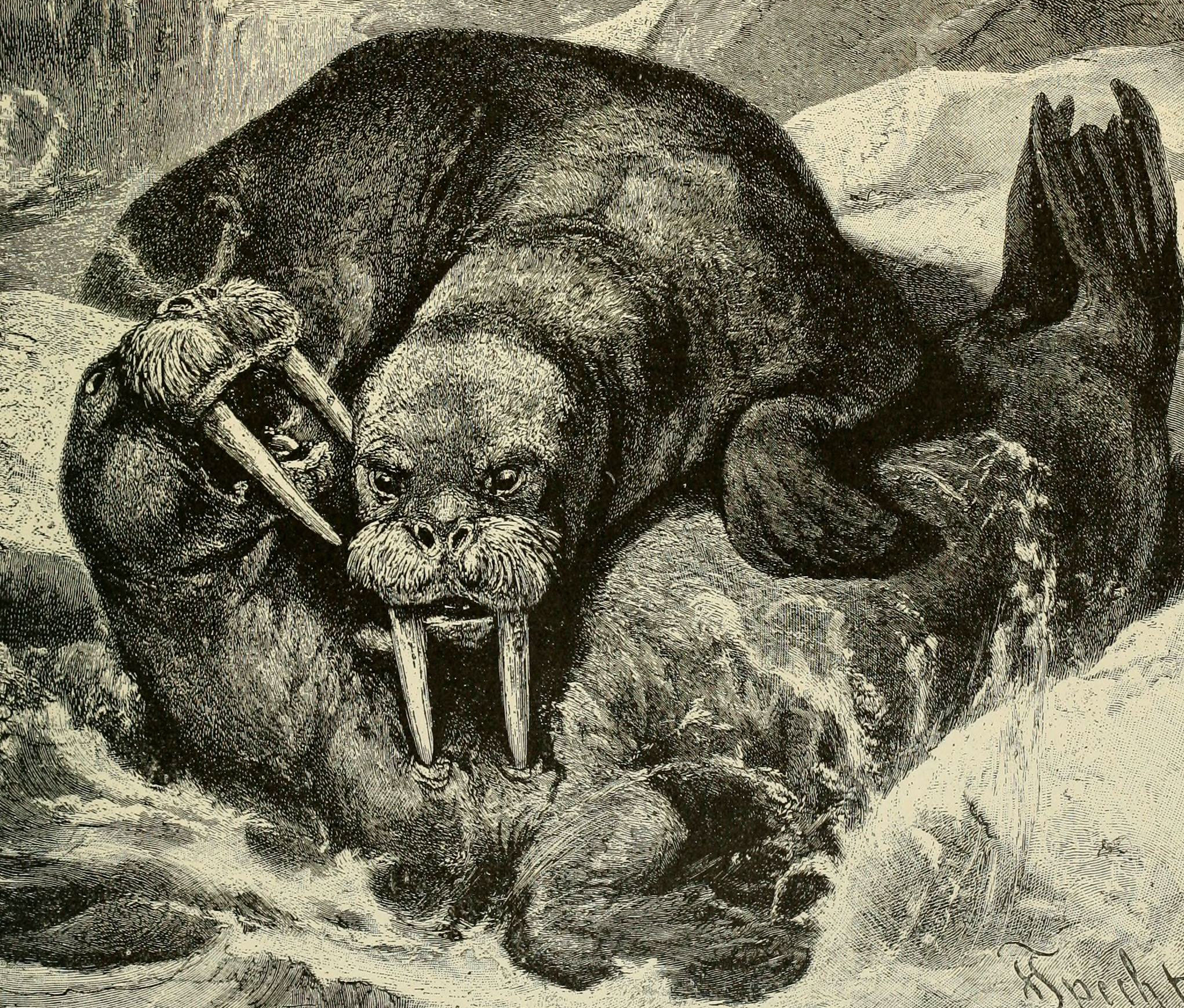
Walrus, Alfred Brehm, Public domain, via Wikimedia Commons
In the 18th and 19th centuries walruses were heavily hunted. There was a market for their fat, skin and ivory. So fierce was the demand, that the population was decimated, and it was eventually extirpated from the region.
That said, occasionally people still have sightings.
Infrequently, walruses from the far north make appearances on in Newfoundland. Locals may recall that, in 2022, a walrus caused quite a stir on the Avalon Peninsula.
-
Sir Humphrey Gilbert, Dictionary of Canadian Biography
Sir Humphrey Gilbert, Dictionary of Irish Biography
Sir Humphrey Gilbert, Encyclopedia of Newfoundland
Sir Humphrey Gilbert: Elizabethan Explorer, Canadian Encyclopedia
Humphrey Gilbert Claims Newfoundland, Englandcast
The life of Sir Humphrey Gilbert, England's first empire builder, W. G. Gosling, 1911
Letters Patent to Sir Humfrey Gylberte June 11, 1578, The Avalon Project
Sir Humphrey Gilbert's Voyage To Newfoundland, 1583, Edward Haies, Sourcebooks, Fordham University
Edward Haies, Dictionary of Canadian Biography
Atlantic Walrus, Sable Island National Park Reserve, Parks Canada
The Late Wisconsinan and Holocene Record of Walrus (Odobenus rosmarus) from North America, A.S. Dyke et al. Arctic, Vol. 52, No. 2 (JUNE 1999)
Walrus makes a rare appearance, CBC, 2022



.jpg)

_(6220165281).jpg)
In 1583 Sir Humphrey Gilbert’s Newfoundland voyage ended in disaster — but not before he spotted a strange creature in the North Atlantic that he could only describe as a lion.
In the summer of 1953, Newfoundland’s had a wave of sea monster sightings. Fishermen and sailors reported strange creatures, newspapers offered rewards, and mystery filled the bays.
A seventy-foot sea serpent sighting in Newfoundland’s Bay of Islands sent fishermen fleeing to shore. What was it? A rare whale? A giant eel? Or something even stranger?
In 1888, fishermen near Fortune Harbour saw something massive in the water—120 feet long, fast, and unlike anything they'd known.
In 1937, a massive sea creature attacked a fishing boat off Tack’s Beach, tearing at the keel and leaving behind three terrifying teeth. Whatever it was—known or unknown—it meant trouble.
In 1912 Josiah Sheppard was fishing off the Bay of Islands when something strange and powerful surfaced beside his small dory. What happened next is a rare and almost unbelievable escape from one of Newfoundland’s mysterious sea creatures.
Discover the mysterious 1937 sea monster captured in Fortune Harbour — a 34-foot creature that baffled fishermen, made headlines, and became a local legend.
Just off Harbour Buffet, Placentia Bay a fisherman vanished, his shattered boat was the only clue. It looked like something, some ocean creature, was responsible.
There are mysteries in the deep but from time to time the come to the surface — here are 10 times Newfoundland sea serpents and lake monsters made the news.
In 1888 the crew of ship Augusta encountered a sea monster off Newfoundland.